

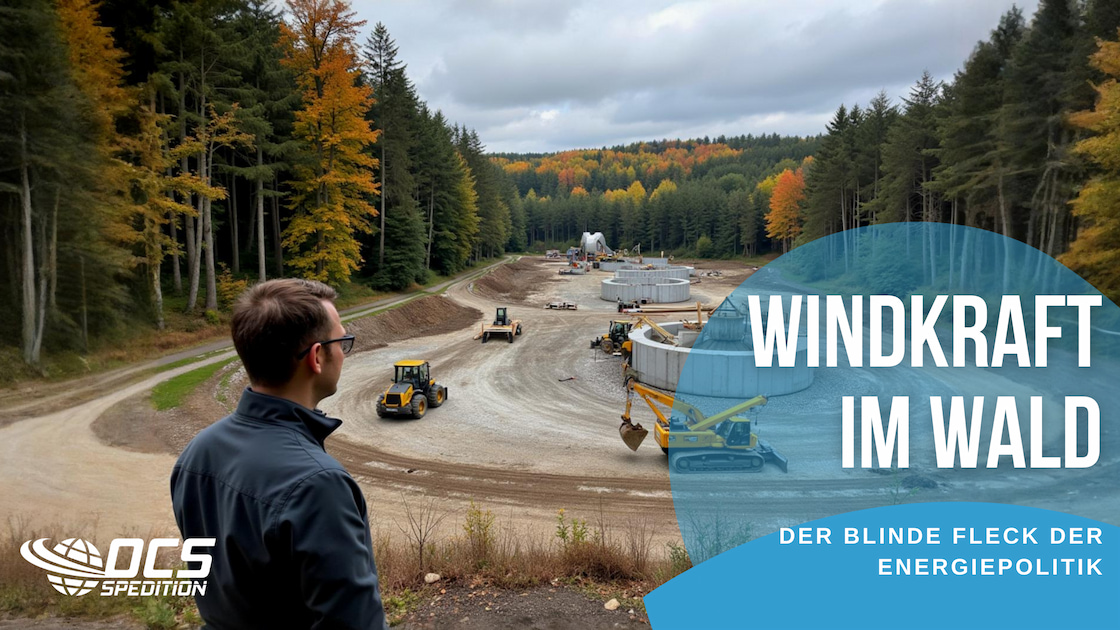
Wind power in the forest: The uncomfortable contradiction between deforestation promises and energy policy
Deforestation-free on paper – industrial areas in the forest in practice
The European Union is making a strong commitment to deforestation-free supply chains. Products such as wood, soy, coffee, or cocoa may only be placed on the market if they do not originate from deforested areas. The goal: global forest protection.
At the same time, however, large-scale deforestation is being permitted in Germany to build wind turbines. Forests are being converted into industrial areas – including access roads, foundations, and permanent soil alteration.
The fact that we sanction deforestation worldwide on the one hand and legitimize it for energy projects in our own country on the other hand strikes me as an almost unparalleled contradiction and, frankly, absurd.
Why this topic is particularly important to me:
Our company is actively committed to forest conservation. For every full truckload (FTL) transport we carry out, we plant a tree in our region. This commitment is not just a formality on paper, but an expression of our personal and corporate values: Forests are not abstract carbon sinks, but living ecosystems.
Against this background, the industrial use of forests for energy production strikes me as particularly negative, especially when it is politically labelled as "ecological".
This is precisely where the contradiction arises: Why do deforestation rules apply to products, but not to electricity from German forests?
The EU-level decision guideline: Deforestation is deforestation
The EU Deforestation Regulation clearly defines deforestation as the permanent conversion of forest areas. This logic applies regardless of the purpose of the land use. Agricultural land is subject to strict due diligence requirements – energy production, however, remains exempt.
Special rights in the forest: When bureaucracy is applied selectively
State forest laws in Germany strictly regulate clear-cutting. Private forest owners must obtain permits for even the smallest interventions, document the areas, provide compensation, and comply with extensive regulations. At the same time, wind farm projects are regularly classified as being of "overriding public interest"—with far-reaching exceptions to the very rules that apply to everyone else. The result is a de facto preferential treatment of industrial actors while simultaneously tightening regulations for private and sustainably managed forest owners.
Furthermore, there is a linguistic reinterpretation that makes decisions easier to justify politically. Clearing becomes "temporary forest use," deforestation "permanent use with a restoration option." What are technically and ecologically irreversible interventions —compacted soils, destroyed water balance, fragmented habitats, and lost biodiversity—suddenly appear harmless and manageable.
Those who soften the language make harsh interventions easier. And that, for me, is precisely the real problem: not only the deforestation itself, but the deliberate downplaying of its consequences undermines any credible forest protection policy. When law and language become so flexible, the very idea of protection loses its substance.
The claimed climate benefits – a sober assessment
Even optimistic calculations conclude that the global CO₂ effect of wind turbines in German forests is barely measurable. Compared to global emissions, the contribution is in the per mille range. However, this is offset by irreversible interventions in local forest ecosystems: soil compaction, fragmentation of established habitats, alteration of the water balance, and the permanent loss of ecological structures that cannot simply be "rebuilt.".
As someone who actively plants trees, observes their growth over years, and knows how much time a forest needs to develop stability and biodiversity, this conflict of objectives is not theoretical for me, but concretely visible. This isn't about abstract emission figures, but about real landscapes, real soils, and real habitats.
There is another point that is rarely addressed openly in the debate: By focusing on “saving the climate” with an ideologically narrow agenda, we risk weakening ourselves economically and structurally. Functioning infrastructure is being abandoned or even actively dismantled – from decommissioned and demolished nuclear power plants to the uprooting of existing gas pipelines. However, prosperity and security of supply are not secondary considerations, but rather the foundation for any long-term environmental policy. When basic needs such as energy supply, economic stability, and social security are jeopardized, environmental protection inevitably takes a back seat.
Those who permanently damage prosperity also weaken a society's ability to seriously and sustainably pursue nature conservation. For me, therefore, the question is not only about the ecological benefits of individual measures, but about their overall impact on the environment, society, and future viability.
Compensatory measures: Buyout instead of restoration
Legally mandated compensatory measures are often monetized in practice. Instead of actual restoration, a payment is made – a so-called substitute payment. However, a newly planted seedling cannot replace a mature forest with a functioning soil and water system.
Because a forest is far more than just a collection of trees on a piece of land. A healthy forest is an ecosystem that has grown over decades, often centuries. The forest floor is formed slowly through the decomposition of leaves, deadwood, and organic material. Within just a few centimeters of humus lies the result of decades of biological processes. Billions of microorganisms, fungal networks (mycorrhizae), insects, and soil organisms form a complex network that stores nutrients, nourishes plants, and sequesters carbon.
Biodiversity is also not a replaceable factor. Old-growth mixed forests offer habitats in multiple vertical layers – from the ground through the shrub zone to the canopy. Many species depend on precisely this structural diversity. Reforestation elsewhere can create new forest in the long term, but it does not replace the ecological value of a system that has developed over generations.
Therefore, the logic of "replacing one for one" falls short from an ecological perspective. It's not about the number of trees planted, but about restoring a highly complex habitat – and that is neither quick-fix nor fully reproducible.
Conclusion: Deforestation-free electricity would be truly innovative
Wind power in forests exemplifies how selectively ecological arguments are applied today. Deforestation is internationally sanctioned, supply chains are regulated down to the last detail, small businesses must provide proof of origin – but when it comes to energy projects within one's own country, suddenly different standards apply. Anyone who is serious about forest protection must defend it even where political goals, investment interests, or ideological narratives become inconvenient.
From both a personal and business perspective, one conclusion remains clear for me: energy production must not come at the expense of functioning forests. A forest is not an interchangeable factor of production or a "temporarily used space," but rather a mature ecosystem with its own dynamics, its own timescale, and irreplaceable functions for soil, water, biodiversity, and climate. To industrially reshape it and then relativize this with language contradicts the very principles of credible environmental policy.
I plant trees myself. For every full truckload (FTL) shipment, we consciously make a statement and invest in regional reforestation. I see how slowly a forest grows. I see how sensitive the soil is. And that's precisely why the carelessness with which established structures are sacrificed for a globally barely measurable effect affects me so deeply.
Climate protection and forest protection are not mutually exclusive. On the contrary: a healthy forest is itself an active form of climate protection. But this only works if the same standards apply – for Indonesia as well as for Hesse, for cocoa as well as for electricity. What would be truly innovative is not deforestation-free chocolate, but deforestation-free electricity. Only then would the argument be consistent.