
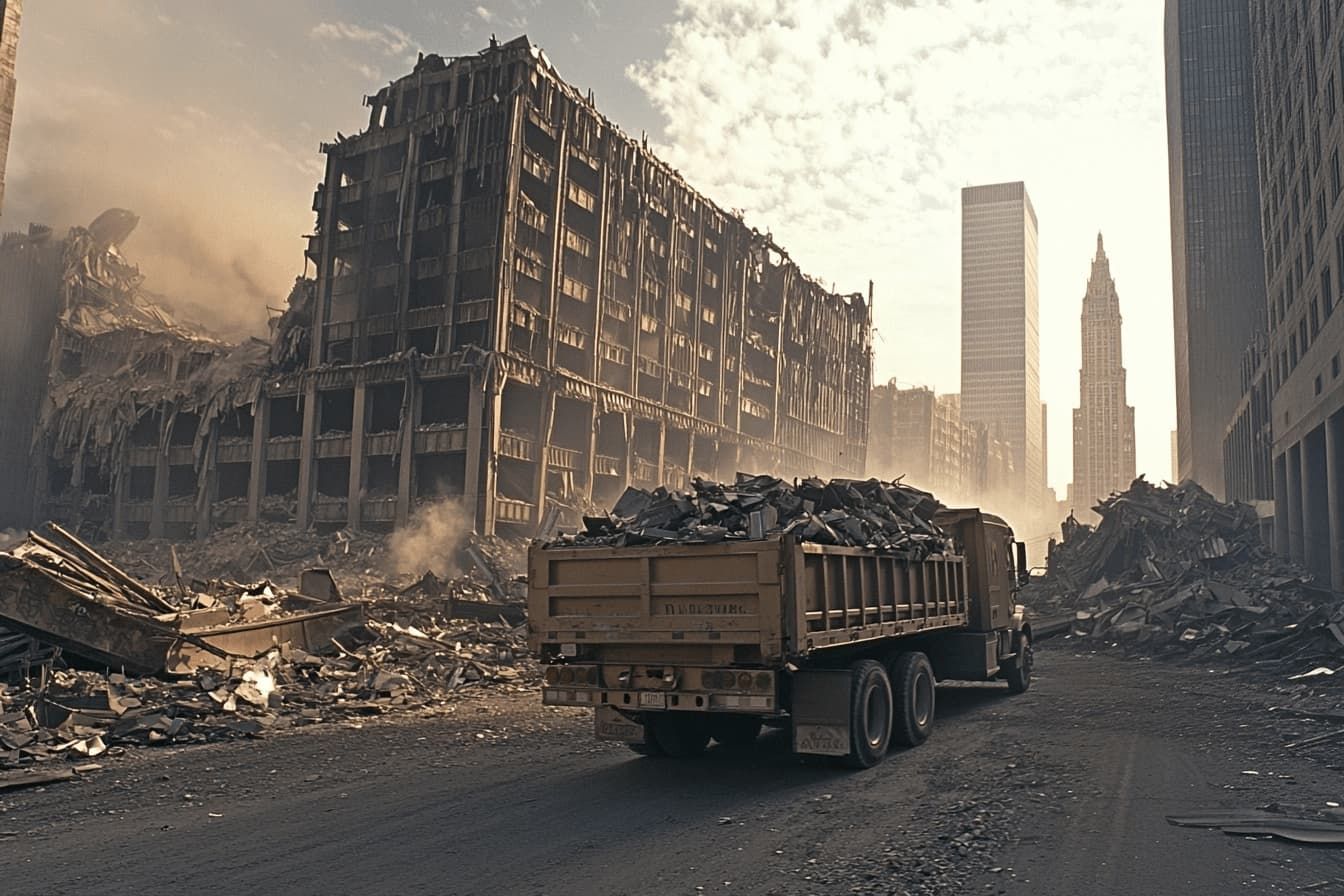
On September 11, 2001, the terrorist attacks shook the world and led to the catastrophic collapse of the Twin Towers of the World Trade Center (WTC). The former heart of New York City, standing at 417 and 415 meters tall, was now nothing but a pile of rubble. The recovery and disposal operations proved to be an enormous logistical challenge, both in terms of human resources and equipment.
The dimensions of the destruction
In total, approximately 1.5 million tons of debris were removed from Ground Zero—a colossal amount of concrete, steel, glass, and plastic. Work began immediately after the attacks and lasted from September 2001 to May 2002. Originally, the cleanup was expected to take two years, but the smooth logistics behind the project allowed it to be completed in less than a year—a remarkable achievement. The enormous quantities of debris had to be carefully sorted to separate construction debris from human remains. The remains of the destroyed buildings and the victims found a temporary home at the Fresh Kills landfill on Staten Island, which was briefly reopened
Recycling and reuse
A significant portion of the steel beams from the Twin Towers were melted down and used for new projects. Of particular note is the USS New York, a warship built with 6.8 tons of steel from the World Trade Center and launched on December 19, 2007. This steel not only contributed to the reconstruction effort but also symbolized the nation's resilience and resilience.
In addition, some of the WTC steel and other materials were exported internationally. Countries like China and India received scrap metal from the rubble, which was used in various construction projects. These global reuse efforts helped to ensure that the far-reaching impact of the tragedy extended beyond the United States.
Memorial sites and educational purposes
Some of the debris was preserved for commemorative purposes and can now be found in various memorial sites. The National September 11 Memorial & Museum in New York City incorporates many of these artifacts and serves as a place of remembrance and education. In addition, pieces of WTC steel were distributed worldwide to be placed in memorials in Canada, Germany, the United Kingdom, and many other countries.
Health impacts and challenges
The rescue operation was not only logistically challenging but also posed a health risk. Many rescue workers and helpers suffered health problems due to asbestos and other pollutants released by the collapse. The deployment of specialists, rescue dogs, and various aid organizations was crucial in managing the situation.
Investigations and costs
The costs for clearing the debris and rebuilding the World Trade Center amounted to several billion dollars. Investigations into the response of emergency services and their equipment revealed weaknesses that led to improvements in emergency plans.
Conclusion
Managing the debris of the World Trade Center was undoubtedly a logistical masterpiece. The extensive disposal, recycling, and creation of memorials, however, represent not only the will to build something new from destruction. They also demonstrate how the United States used this tragedy to strengthen its political and military power worldwide. The recycled steel used for warships like the USS New York symbolizes not only the reconstruction but also the close connection between the attacks and the subsequent military interventions. At the same time, it is important to remember that the cohesion and determination of the logistics experts involved were crucial in clearing the debris in record time. This mission was so deeply rooted that it was completed in less than a year—far ahead of schedule.