
Pallet handling under stress: From Poland to pallet pooling – what really works?
Pallet swapping sounds simple in theory: A truck brings 33 empty pallets to the loading point, delivers them, receives 33 loaded pallets back, delivers them to the recipient, and picks up 33 empty pallets there.
But the reality is: pallet swapping problems have been a part of everyday logistics for decades.
I've been working on this topic for over 20 years – and there's still no comprehensive, seamless solution.
Where the problems with pallet exchange begin
- Missing pallets at pickup: Many drivers don't have any pallets at all. This causes delays even at the ramp.
- Space on the loading area: Taking empty pallets with you costs space – and therefore money.
- Pallet quality: Drivers drop off good pallets but receive damaged ones back. Arguments are inevitable.
- High administrative costs: complaints, pallet receipts, consultations with customers, senders and recipients – studies estimate the costs at around €4 per exchange , mostly at the expense of the carrier or freight forwarder.
Practical example: Poland pallet exchange in beverage transport
This issue became particularly clear in an order for a customer in the beverage industry.
We regularly delivered to the central warehouse of a Polish discounter – a well-known name in Germany as well.
However, the Polish pallet exchange system there operated according to its own rules:
- Drivers received poorer or damaged pallets back.
- Discussions with the loading personnel were everyday occurrences.
- The warehouse protected itself with a sign at the exit:
“Upon leaving the premises, any claim to pallets expires.”
The result: Hardly any freight carriers wanted to travel there anymore. Our customer's transport costs rose significantly.
Their reputation in the industry suffered, as they had been burned as a "straightforward partner."
This example shows that poor pallet handling can not only destroy costs, but also trust and market share.
Market conditions as an additional factor
The willingness to exchange pallets depends heavily on the current market situation:
- In times of limited capacity, freight carriers seek out the most lucrative contracts – often without exchanging pallets.
- If they urgently need cargo, they also accept transports with exchange, despite the additional costs.
The pallet exchange therefore remains a fluctuation factor that complicates planning.
Pallet handling: approaches and alternatives
- Pallet pooling: Pooling service providers manage centralized inventories. Freight carriers can pick up pallets at depots and drop them off elsewhere.
- Pallet returns: Some shippers collect pallets from the recipient and return them in full loads. The advantage is that they are usually the same pallets – but this is never 100% certain.
- Calculate pallet costs: Some suppliers pass these costs on to their customers. However, in competitive markets, this is often a disadvantage.
Cost factor pallet exchange (DSLV study 2022)
A study commissioned by the German Freight Forwarding and Logistics Association (DSLV), conducted by Prof. Dr. Dirk Lohre, examined the costs of empty pallet handling. The result: Pallet exchange costs an average of around €5.70 per pallet. Depending on quality requirements (e.g., only new or high-quality pallets), these costs can rise to over €6.70 per pallet.
The study makes it clear that pallet exchange is not only challenging from an organizational and logistical perspective, but also a clearly measurable cost factor that has a significant impact on the economic efficiency of transport.
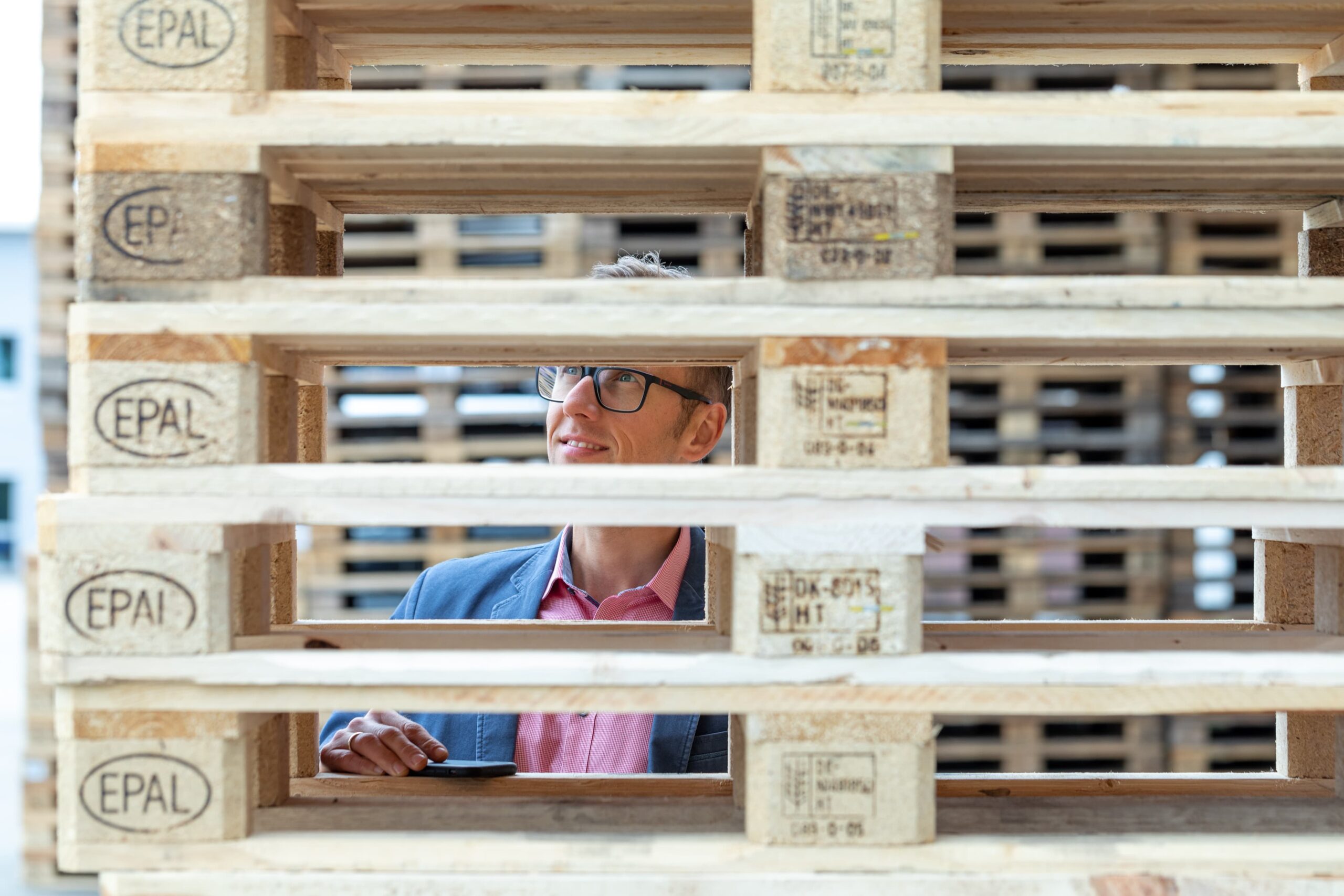
EPAL relies on QR technology
also breaking new ground to digitally overcome the challenges of pallet exchange. With the EPAL Europallet QR and the associated EPAL Pallet App, the association is leveraging modern technologies: pallets can be scanned, tracked, and managed in real time using a QR code. This reduces manual input, eliminates paper-based processes, and creates transparency over stocks and movements, both internally within the company and in exchanges with partners. The goal is to minimize losses, increase efficiency, and sustainably lead pallet logistics into the digital future.
Our approach: Flexible pallet handling
A universal solution for pallet exchange doesn't exist (yet). That's why we focus on flexibility and customized concepts:
- Every sender, recipient and transport is different.
- We design customized pallet and transport processes that fit your requirements.
- Whether it’s traditional pallet exchange, pallet pooling, or alternative solutions – we’ll find the best way.
Do you have a specific pallet handling challenge? Challenge us – we'll develop the right solution!
Conclusion: Pallet exchange remains a persistent problem – but not unsolvable
I've been involved with pallet exchange for over 20 years. The multitude of variables, from quality and availability to processes and market conditions, makes it one of the most complex topics in logistics.
And during this time, countless solutions and systems have come onto the market: from traditional bartering procedures to pooling models, digital tracking tools, software-supported pallet accounts, and QR-based processes.
All of these approaches offer enormous potential, but their effectiveness depends heavily on which solution fits the company's individual requirements. What represents a significant increase in efficiency for one shipper may be unnecessarily complex or costly for another.
This is precisely the crucial point: Success comes from the convergence of technology, experience, and understanding of customer processes. We see it as our task to understand this diversity of options, evaluate them, and design a customized solution for each customer, regardless of whether it is digital, traditional, or hybrid.