
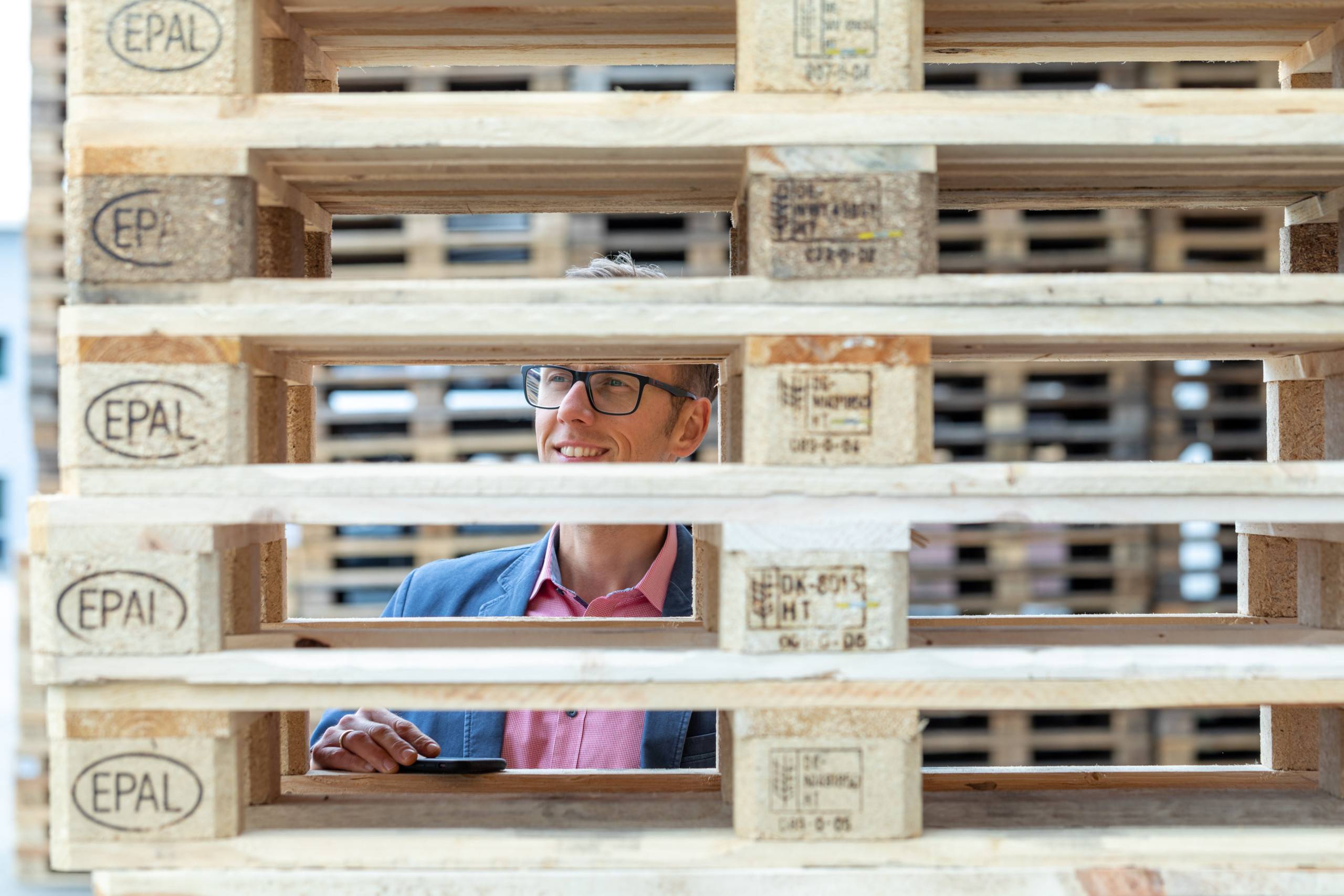
Pallets were a true breakthrough invention in logistics during the 1930s. Suddenly, it became possible to bundle and transport compact shipments, even in large formats. Since pallets have always been used as stable, reusable packaging worldwide, exchanging them during loading and unloading seems like a natural solution. However, this exchange is not as simple as it sounds.
The challenges of pallet exchange are part of the daily routine at OCS Spedition. For example, a customer recently approached us with a "pallet challenge." Large shipments from Poland and the Czech Republic to Germany were planned for his clients, consisting of large discount stores and retail chains. The requirement: exchanging the pallets on-site. This was nothing new with standard Euro pallets, even though it always involves risks for the transport company.
The challenge, however, was delivering the goods on Düsseldorf pallets. While the supplier could guarantee this, they would either charge our customer a fixed price for the pallets or demand their return through a standard exchange process. An insurmountable problem?
What are Düsseldorf pallets?
The pallet known as the Düsseldorf pallet meets all the requirements that trade and industry place on transport packaging. The only difference to the standard Euro pallet is its smaller size, measuring 80 x 60 cm, making it significantly more manageable. Another advantage for warehouse handling is that, like a Euro pallet, the DD pallet can be accessed from all standard-sized pallet jacks and forklifts from four sides, not just two. When used in direct exchange, Düsseldorf pallets are also more cost-effective than Euro pallets.
The challenges of pallet exchange
However, the option to exchange pallets isn't without its drawbacks. It's usually very frustrating when, after unloading, it's discovered that the delivered pallets were in significantly better condition than those intended for collection. While various standards exist to try and regulate these unpleasant situations, reality repeatedly confirms that a reasonable pallet condition almost always depends on too many uncontrollable factors. Logistics thrives on speed, and unfortunately, maintaining a sufficient inventory of good, exchangeable pallets plays a subordinate role in logistical processes. The additional costs for poor-quality pallets are often borne by the freight forwarder. Although the German trucking law website LKW-Recht has published some regulations, compliance is often difficult. Various software solutions promise simplified processing and cost savings, but these still need to prove themselves in practice.
The solution for pallet exchange
Naturally, the OCS team sought the optimal solution for the aforementioned example. However, making this business possible for our client required the well-known practice of "thinking outside the box." The final implementation involved setting up and maintaining an exchange account to return the pallets in larger batches using fully loaded trucks. The pallet accounts could thus be recorded in the system and regularly reconciled, allowing recipients to exchange the Düsseldorf pallets gradually upon receiving their goods.
One more pallet in circulation
But this presented the dispatchers with the next challenge. The new DD pallet format couldn't be easily integrated into the existing Euro pallet shipments. And especially where every single pallet space is crucial, there's simply no spare room on the loading platform. The solution: utilizing a network of various pallet handling service providers and small freight forwarding warehouses located in close proximity to the recipients. The unloaded pallets could then also be recorded in the pallet management system, giving both the customers and OCS dispatchers a constant overview of the various inventory levels.
And what about the pallets in the return process?
Once the pallet inventory in a region was consolidated into a full load, a truck was dispatched to return it to the supplier to replenish the stock there. The advantage: This ensured that only undamaged exchange pallets were returned to the supplier. During storage, the partners checked the inventory and repaired or disposed of any damaged pallets. This allowed the customer to meet the requirements of retailers in Germany while simultaneously minimizing pallet handling costs.
Benefit from OCS's experience!
The employees of OCS Spedition don't see problems, only challenges – thanks to our strong network, we've already been able to provide many additional services to our customers facing similar challenges. Interested in more information? Feel free to contact us!