
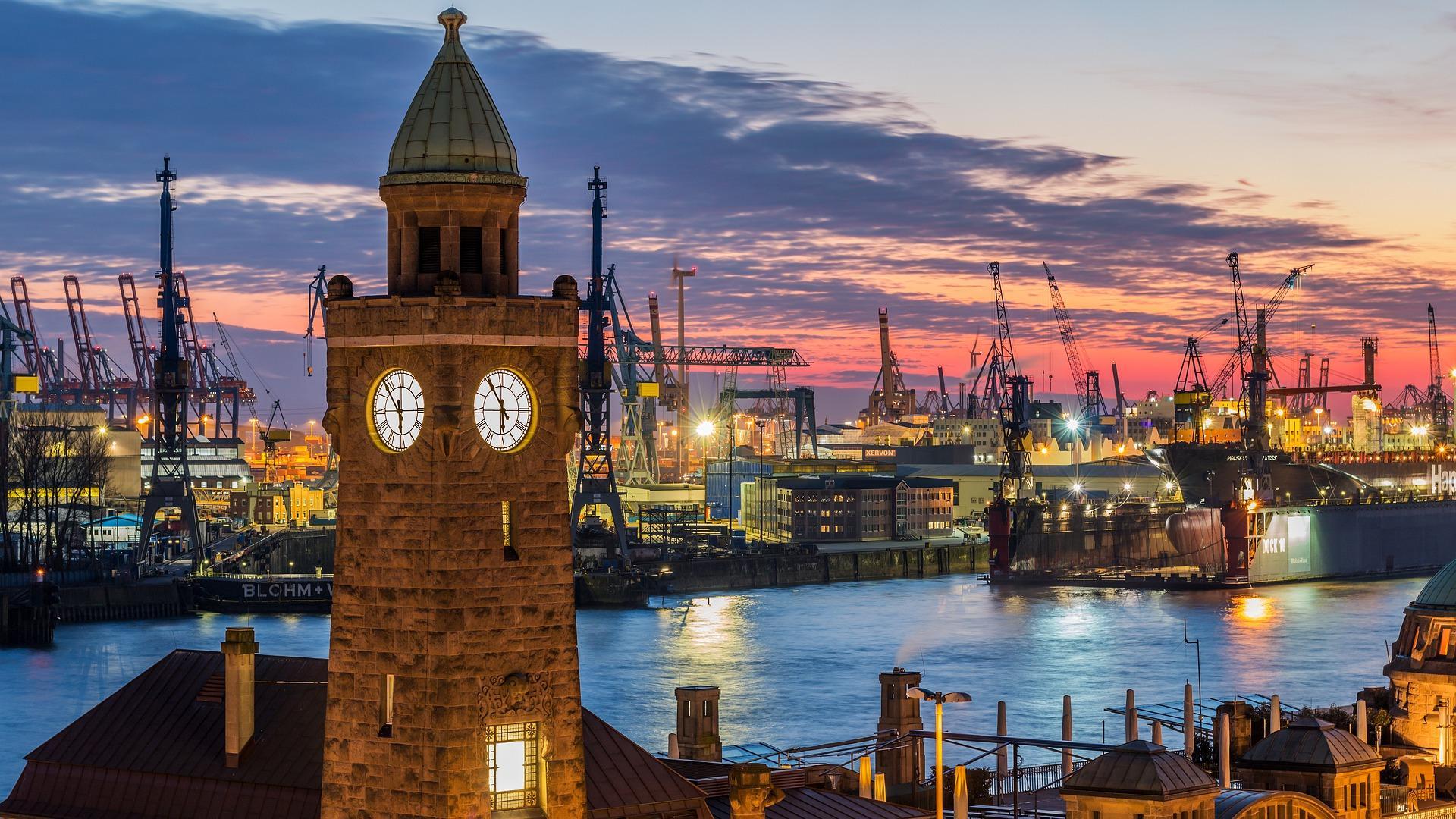
What comes to mind when someone tells you about Hamburg's Port Anniversary? Do you hear the sounds of an accordion and sea shanties, see the seagulls perched on the bollards searching for food, or perhaps even hear the cries of the fish market vendors? Hamburg's port has charm – and is one of the most important hubs in global maritime traffic. OCS took a look at the logistical "behind-the-scenes" of this world filled with containers.
The success story of the Port of Hamburg began with a small landing place in Hamburg's old town in the 9th century, which was granted port rights in 1189. Since then, the port has grown steadily and established itself over the centuries as the most important port of call for maritime traffic in Germany. Today, the facts are almost awe-inspiring: around 8,000 ships call at the port each year and can berth at one of the nearly 300 berths along the 43 kilometers of quays. In addition, more than 2,300 freight trains arrive each week and need to be loaded. Loading and unloading are carried out using four state-of-the-art container terminals, three cruise terminals, and around 50 specialized transshipment facilities for mobile RoRo and general cargo shipments, as well as bulk goods of all kinds. It is therefore not particularly surprising that nearly 7,300 logistics companies have found a home within the city limits. And believe us, these are just some of the facts that the Port of Hamburg Marketing e. V. is particularly proud of.
The location on the Elbe
As Germany's largest port and one of the few ports worldwide located in the heart of a major city, the Port of Hamburg is a defining feature of the city and its image. Its only real drawback: the journey for container ships up the Elbe River to the port is extremely long. As early as 90 kilometers before Hamburg, near Brunsbüttel, the ships enter the Elbe estuary from the North Sea, having passed Heligoland and Cuxhaven and thus reached the German border. From this point on, pilots are responsible for guiding the enormous vessels safely into the port – because even for an experienced captain with a fully loaded ship almost 400 meters long and over 50 meters wide, this is anything but a walk in the park, even if one is familiar with the treacherous narrow channels of the Elbe.
Water freight hub
The handling volumes speak for themselves: In 2018, 8.73 million TEU (twenty-foot equivalent units) were unloaded, transshipped, and loaded, which equates to over 23,900 containers per day. This amounted to approximately 135.1 million tons of freight for international maritime transport. But it's not just goods that depart from or return to Hamburg across the sea: Around 900,562 passengers checked in on cruise ships and other vessels. While the Port of Bremerhaven benefits primarily from the profitable transshipment of motor vehicles destined for North America, Hamburg's cargo is heavily focused on Asia. Shipping profits from international globalization, with China being a major customer.
In Hamburg, we say goodbye!
At least that's what Heidi Kabel, who sang about the sailor who ran away to Shanghai, once claimed. Yet Hamburgers are known as friendly hosts, cosmopolitan and helpful. This is evident during the annual Port Anniversary celebrations, which draw more than a million visitors to the city on the Elbe River on the first weekend in May to experience the harbor atmosphere. Safety is always paramount: the water police patrol 24 hours a day to combat smuggling, terrorism, and other crimes, thus ensuring the safety of the crews.
Shipping is the "engine" of international globalization
In terms of size, Hamburg lags behind Antwerp (Belgium), the second-largest port in Europe, which handles the highest volume of general cargo worldwide. The largest European port, however, is Rotterdam in the Netherlands, which is by far the largest deep-water port on the European continent. In 2018, 468.98 million tons of sea freight were handled at the Rhine-Meuse-Scheldt delta.
Looking to the future, it's safe to say that the importance of the Port of Hamburg for Germany's economy will not diminish in the coming decades. The volume of cargo handled for global shipping to and from Germany is expected to continue increasing, and the technology will undergo significant changes. The Hamburg Port Authority has launched a project that is expected to become commonplace on the Elbe River within just a few years. Various scientists and specialized companies have developed autonomous underwater drones that glide through the harbor basins, using their own navigation system to locate shallows and silt deposits on the riverbed. The collected data will allow dredgers to remove these unwanted silt mounds – initial tests have been very promising, and regular operation is anticipated within a few years.
Research is also extremely important in other areas of logistics, with many measures being relevant for both land and sea transport. But before flying containers, self-driving ships, freight trains, and electric trucks that find their way to terminals without drivers become commonplace, we, as your trusted freight forwarder, will support you in all aspects of your transport needs.